- Veeaar Engineering
- Sep 23, 2026
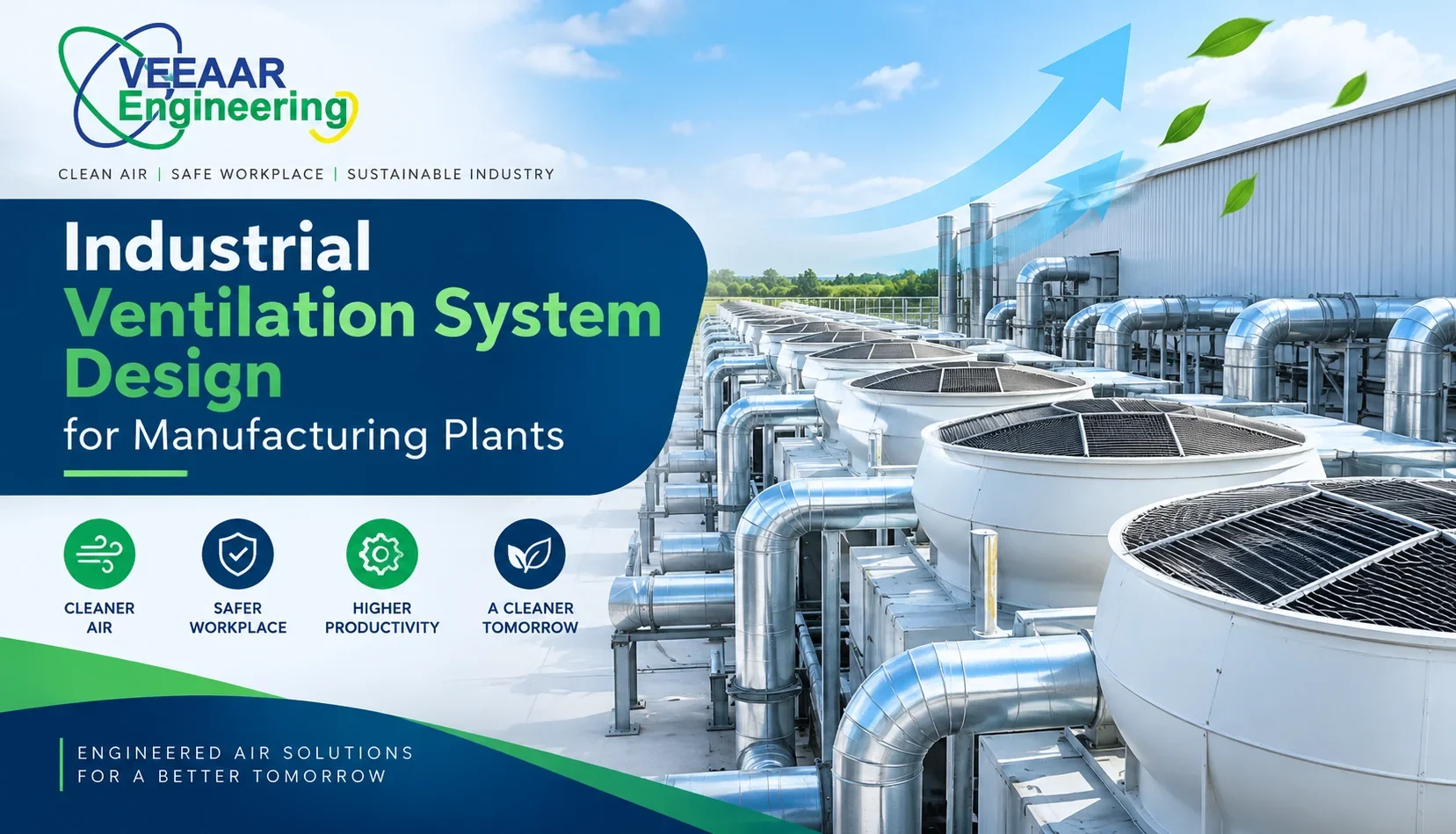
An industrial ventilation system is not simply a collection of exhaust fans. In a manufacturing plant, it is an engineered air-management system that controls heat, dust, fumes, vapours, smoke, and replacement air without disrupting the process. The right design protects people and equipment while making the plant easier to run. The wrong design often creates familiar problems: hot work zones, dust on machines, fumes drifting past workers, difficult-to-open doors, and high electricity use with little improvement in air quality.
For a manufacturer comparing solutions, the key decision is not just which fan to buy. It is how air should move through the building, what must be captured at source, what needs filtration, and how much clean air must replace what is exhausted. This guide explains how to evaluate industrial ventilation design before finalising a system for a manufacturing plant.
A well-designed industrial ventilation system removes contaminants and excess heat close to where they are generated, moves the air through correctly sized ducts and filtration equipment, and introduces adequate make-up air. The design should be based on the actual process, pollutant, building layout, production pattern, and local compliance requirements - not on floor area alone.
What is an industrial ventilation system
Industrial ventilation is the deliberate movement and treatment of air inside a work environment. It uses a combination of hoods, ducts, fans, filters, scrubbers, air inlets, roof ventilators, monitoring points, and controls. Depending on the application, the system may dilute heat or airborne contaminants across a space, capture emissions at a machine, or do both together.
In factory ventilation, the objective is to keep contaminant concentration and temperature within acceptable working conditions. That may mean drawing welding fume into a local extraction hood, collecting grinding dust through a ducted dust collector, removing oil mist from machining areas, exhausting process vapours through a scrubber, or supplying cooler filtered outdoor air to balance a hot production floor. Industrial air management works only when these components are considered as one system.
Why manufacturing plants need a designed solution
Manufacturing processes rarely create a uniform air problem. A fabrication bay may release intermittent welding fume, while a polishing station produces fine dust continuously. A press shop may be dominated by heat, and a chemical process line may require controlled extraction of corrosive vapours. General ventilation may make a hall feel less stuffy, but it cannot reliably control a concentrated emission at a worker breathing zone.
A designed system helps management address several outcomes at once: safer work areas, lower dust deposition on equipment and finished goods, improved comfort, reduced odour migration, better visibility, and more consistent conditions for sensitive operations. It also supports a more orderly maintenance programme because filters, ducts, fans, and collection points are selected around known loads rather than added reactively after complaints arise.
The first design question is what must be controlled
Before sizing airflow, identify the pollutant and the source. This is the foundation of industrial ventilation design. A walk-through should map each operation, the material used, the location of workers, the direction of natural air movement, doors and louvres, nearby equipment, and operating hours. Site observations are more useful than generic airflow rules because they show where contamination actually travels.
For each source, record whether the emission is hot or cold, light or heavy, continuous or occasional, and hazardous or nuisance-only. Also note whether it can be captured before it disperses. This determines whether the plant needs local exhaust ventilation, general dilution ventilation, a process enclosure, or a combined approach.
| Plant condition | Typical source | Design response |
|---|---|---|
| Fine dust | Grinding, sanding, cutting | Source hood, ducting and dust filtration |
| Fume or mist | Welding, machining, thermal process | Local extraction with suitable filtration |
| Heat load | Furnaces, presses, people, machinery | High-level exhaust plus planned make-up air |
| Vapour or gas | Chemical handling, plating, cleaning | Enclosed capture and compatible treatment |
| General stale air | Large occupied production spaces | Balanced supply and exhaust ventilation |
Local exhaust ventilation versus general factory ventilation
Local exhaust ventilation, often called LEV, captures a contaminant close to its point of release. It normally includes a hood or enclosure, branch duct, airflow control, main duct, fan, air-cleaning device, and discharge point. It is generally the preferred method for dust, fumes, mist, and vapours because it prevents the contaminant from entering the wider workspace.
General factory ventilation uses planned supply and exhaust to dilute heat, moisture, odour, or low-level emissions across a larger area. Roof extractors, wall fans, louvers, supply air fans, and evaporative cooling may all form part of this strategy. It can be effective for broad heat loads and whole-building comfort, but it should not replace source capture where workers are exposed close to the process.
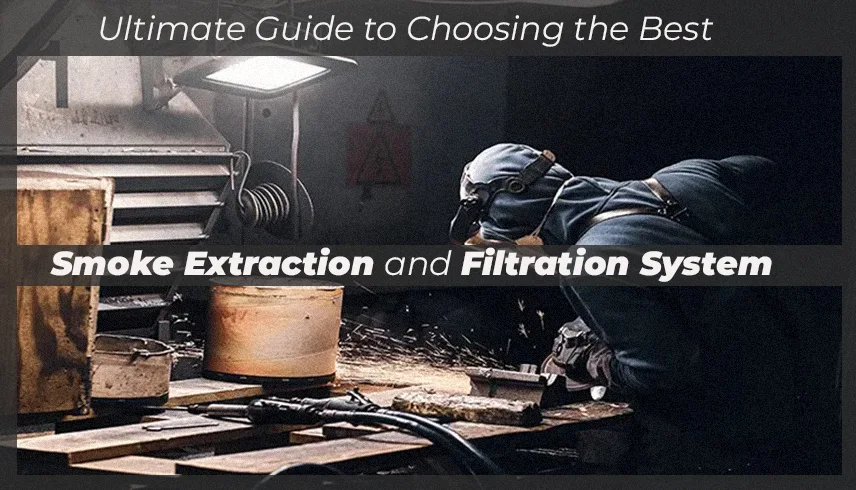
Most busy plants need both. A welding shop may use extraction arms or hoods at welding stations, then use high-level exhaust and make-up air to control residual heat and maintain overall airflow. The system should be arranged so supply air supports capture rather than blowing fume away from the hood.
Core elements of an industrial ventilation system
Capture hood or enclosure. The hood must be close enough to intercept the emission and shaped to suit the process. A well-sized fan cannot compensate for a hood that is too far away, blocked by fixtures, or positioned on the wrong side of the plume. Partial enclosures are often more effective than open hoods because they reduce the airflow needed for capture.
Ductwork. Ducts carry contaminated air at a velocity appropriate for the material being transported. Poor routing, abrupt bends, undersized branches, and uncontrolled connections add pressure loss and reduce performance at the point of capture. Design should include cleaning points, support spacing, expansion, corrosion resistance, and future changes in production layout.
Air-cleaning equipment. The filter or treatment technology must match the contaminant. Cartridge or bag filters may suit dry dust, mist collectors are designed for oil aerosols, and wet scrubbers may be appropriate for certain soluble or corrosive gases. Selection should include loading pattern, particle characteristics, discharge requirements, maintenance access, and waste disposal.
Fan and motor. The fan must deliver the required volume of air at the actual system static pressure, not merely the airflow shown in a catalogue. Fan selection affects noise, energy use, reliability, and the ability to maintain capture as filters load.
Make-up air. Every cubic metre of air exhausted has to be replaced. Without adequate make-up air, the building becomes excessively negative, doors become difficult to operate, uncontrolled air enters through gaps, and extraction can weaken. Replacement air should be introduced cleanly and gently, away from the capture zone.
A step by step approach to industrial ventilation design
1. Study the process and layout. Begin with material flow, machine positions, worker locations, shift patterns, and planned capacity increases. Ask operators where heat, dust, fumes, and odours are worst. The design should reflect the plant at peak operation, not a quiet inspection day.
2. Define the design objective. Decide whether the priority is contaminant capture, heat removal, odour control, smoke extraction, equipment protection, or a combination. Quantify the required outcome where possible, such as airflow at a hood, temperature reduction, or dust collection at a specific machine.
3. Select the control strategy. Source capture is normally the first choice for process emissions. General ventilation can support it, while isolation, enclosure, modified process methods, and housekeeping reduce the load that the system must manage.
4. Calculate airflow and pressure requirements. Airflow must meet the capture or dilution need. The total pressure must include losses through hoods, ducts, bends, dampers, filters, scrubbers, stack, and discharge. A detailed pressure-loss calculation makes fan duty transparent and helps prevent underperformance.
5. Plan supply air and discharge. Locate make-up air away from contaminant sources, avoid short-circuiting between inlet and exhaust, and ensure the discharge point does not allow contaminated air back into the building or nearby occupied areas. Consider prevailing wind, roof geometry, nearby openings, and future construction.
6. Design for maintenance and verification. Include differential-pressure indicators, access for filter change, inspection doors, safe collection-bin handling, and a commissioning plan. Test at start-up and check periodically; airflow and pressure readings make performance visible.
Factory ventilation design factors buyers should compare
When comparing proposals, ask suppliers to explain the design basis, not only provide a list of equipment. Two quotations with the same number of fans can have very different value if one includes source capture, calculated duct sizing, suitable filtration, balancing, commissioning, and after-sales support.
Airflow at each critical point. Request the required airflow at every hood, machine connection, and general exhaust point. Total air volume alone does not prove capture at the process.
Static pressure and fan duty. The proposal should state the calculated static pressure and fan operating point. This makes it easier to check whether the fan can overcome filter loading and system resistance.
Material compatibility. For abrasive dust, corrosive vapours, hot air, sticky mist, or combustible material, the hood, duct, filter, fan, and seals must be chosen accordingly.
Energy and controls. Consider motor efficiency, variable-speed drives, zoned extraction, automatic dampers, and operating schedules. Energy reduction should never compromise the required extraction rate.
Lifecycle cost. A low initial price may create higher filter replacement, cleaning, power, downtime, and repair costs. Compare operating cost and serviceability alongside capital cost.
Common industrial air management mistakes
A common mistake is installing a large exhaust fan and assuming more airflow will solve a source problem. If the hood is poorly positioned, high airflow may pull conditioned air from doors and windows without collecting the emission. Another is ignoring make-up air, which can starve the exhaust system and create uncomfortable drafts. Oversimplified duct layouts, no allowance for dirty filters, and shared systems that connect incompatible contaminants are other recurring issues.
Plants also lose performance after installation when production changes but the ventilation design does not. A new grinding wheel, extra welding station, changed machine location, or different raw material can alter loading significantly. Review the system whenever the process changes, and treat maintenance as part of the design intent rather than an afterthought.
Applications across manufacturing plants
Industrial ventilation systems are used across metal fabrication, automotive and component manufacturing, machining, food processing, pharmaceuticals, packaging, chemicals, plastics, rubber, electronics, warehousing, and process industries. The design differs by application: welding needs fume capture, CNC machining may need oil-mist filtration, powder handling requires dust collection, and heat-intensive operations need planned heat removal and make-up air.
Veeaar Engineering provides industrial ventilation and air-filtration solutions as part of its wider air and water management offering. For a manufacturing plant, the most useful starting point is a site-specific discussion around the process, pollutants, layout, and performance goal. This makes it possible to select an industrial ventilation system that fits the operation rather than adapting the operation around generic equipment.
How to prepare for a supplier discussion
Prepare a simple process list, plant layout, machine count, operating hours, material safety information where relevant, utility availability, and photographs or videos of the problem areas. Note complaints such as visible fume, dust on stock, heat near a line, odour, or frequent filter choking. Also share any planned expansion. Clear inputs allow the supplier to recommend a practical industrial ventilation design and identify whether local extraction, filtration, make-up air, cooling, smoke extraction, or a combination is needed.
Commissioning and long term performance
Commissioning turns a design into a working industrial ventilation system. At handover, the installation should be checked against the approved drawings and performance requirements. Confirm that hoods are installed at the correct locations, dampers are set, ducts are supported, fan rotation is correct, filters are seated, drains and collection points are accessible, and electrical controls operate as intended. Measuring and recording airflow at key hoods, fan static pressure, motor current, and filter differential pressure creates a baseline for future maintenance.
This baseline matters because ventilation performance changes slowly. Filters load, ducts collect residue, belts and bearings wear, flexible connections deteriorate, and operators may move a hood to make room for work. Without original readings, a weak system can look normal until complaints become frequent. A simple log of pressures, airflow, maintenance dates, and observed issues helps a plant identify decline early and schedule corrective work before production is affected.
Training is equally important. Operators should understand why a hood needs to remain close to the source, why an enclosure should not be left open unnecessarily, and who to inform when airflow seems weak. Maintenance teams need clear access and safe procedures for filter replacement, dust disposal, fan isolation, and duct cleaning. The best engineered system will underperform if it is difficult to use or maintain.
Compliance and risk considerations
Ventilation design should be aligned with the plant's applicable occupational health, fire safety, pollution-control, and building requirements. The exact obligations depend on the industry, material handled, location, and process. For example, combustible dust, corrosive gas, solvent vapour, hot smoke, and food or pharmaceutical production can each introduce special requirements for materials, separation, monitoring, discharge, or maintenance. A competent supplier should ask about these conditions before proposing equipment.
Do not treat compliance as only a documentation exercise. The operational objective remains practical: protect people, prevent contamination from moving into clean areas, and keep equipment functioning safely. Where a process has a significant hazard, seek a detailed assessment from appropriately qualified professionals and retain commissioning and maintenance records as part of the plant's safety system.
Frequently asked questions
1. What is an industrial ventilation system?
It is an engineered arrangement of air inlets, hoods, ducts, fans, filters, and controls used to remove heat, dust, fumes, vapours, or stale air from industrial work areas.
2. How is industrial ventilation different from an exhaust fan?
An exhaust fan is one component. A complete system is designed around capture, duct resistance, filtration, make-up air, discharge location, and measurable performance.
3. When is local exhaust ventilation required?
Use it when emissions are created at a defined source, such as welding, grinding, cutting, mixing, spraying, machining, or chemical handling. Capturing close to the source is usually more effective than diluting the whole room.
4. Can factory ventilation reduce heat?
Yes. High-level exhaust combined with correctly placed make-up air can remove accumulated heat. The approach depends on process heat, building height, climate, and whether cooling is also required.
5. What information is needed to design a system?
The process, materials, emission type, machine locations, operating hours, building layout, existing ventilation, utility details, and future expansion plan are useful design inputs.
6. How is required airflow decided?
It is calculated from the capture need or dilution requirement, then checked with duct velocities and system pressure loss. It should not be selected from floor area alone.
7. Why is make-up air important?
It replaces exhausted air. Without it, negative pressure can reduce extraction performance, cause drafts, and pull unfiltered outdoor air into the plant through gaps.
8. Which filter is best for industrial dust?
It depends on dust size, loading, moisture, abrasiveness, and disposal need. Cartridge and bag filters are common for dry dust, but selection requires process assessment.
9. Can one system handle dust and fumes together?
Not always. Incompatible contaminants may require separate systems because mixing can affect filtration, maintenance, safety, or disposal.
10. How often should a system be checked?
Inspect it routinely and verify airflow, pressure drop, fan condition, duct cleanliness, and filter condition on a planned schedule. Check again after any process or layout change.
11. Does a variable-frequency drive save energy?
It can, particularly where extraction demand varies. However, the control strategy must preserve the airflow required for capture at every active station.
12. What causes poor capture at a hood?
Common causes include excessive hood distance, cross-drafts, insufficient airflow, blocked ducts, loaded filters, poor hood shape, and incorrect operator use.
13. Can ventilation improve product quality?
Yes. Reducing dust, mist, and uncontrolled temperature can help protect finished surfaces, machinery, electronics, and sensitive production processes.
14. What should be included in a supplier quotation?
Ask for scope, airflow, static pressure, fan duty, filtration method, materials, controls, make-up air approach, installation scope, commissioning, maintenance needs, and exclusions.
15. How do I choose an industrial ventilation company?
Choose a provider that studies process and site conditions, explains the design basis, offers compatible filtration and airflow solutions, and supports installation, testing, and maintenance.
Plan ventilation around the process not the product catalogue
A manufacturing plant gets better results when industrial ventilation is treated as a process-control decision. The best solution begins with what is generated, where people work, how the air moves, and how the plant will operate tomorrow. Veeaar Engineering can help evaluate industrial ventilation, air filtration, dust and fume control, smoke extraction, and related industrial air-management requirements for a practical, application-led solution. Contact the team to discuss your plant layout and receive a system recommendation built around your operating conditions.