- Veeaar Engineering
- Sep 30, 2026
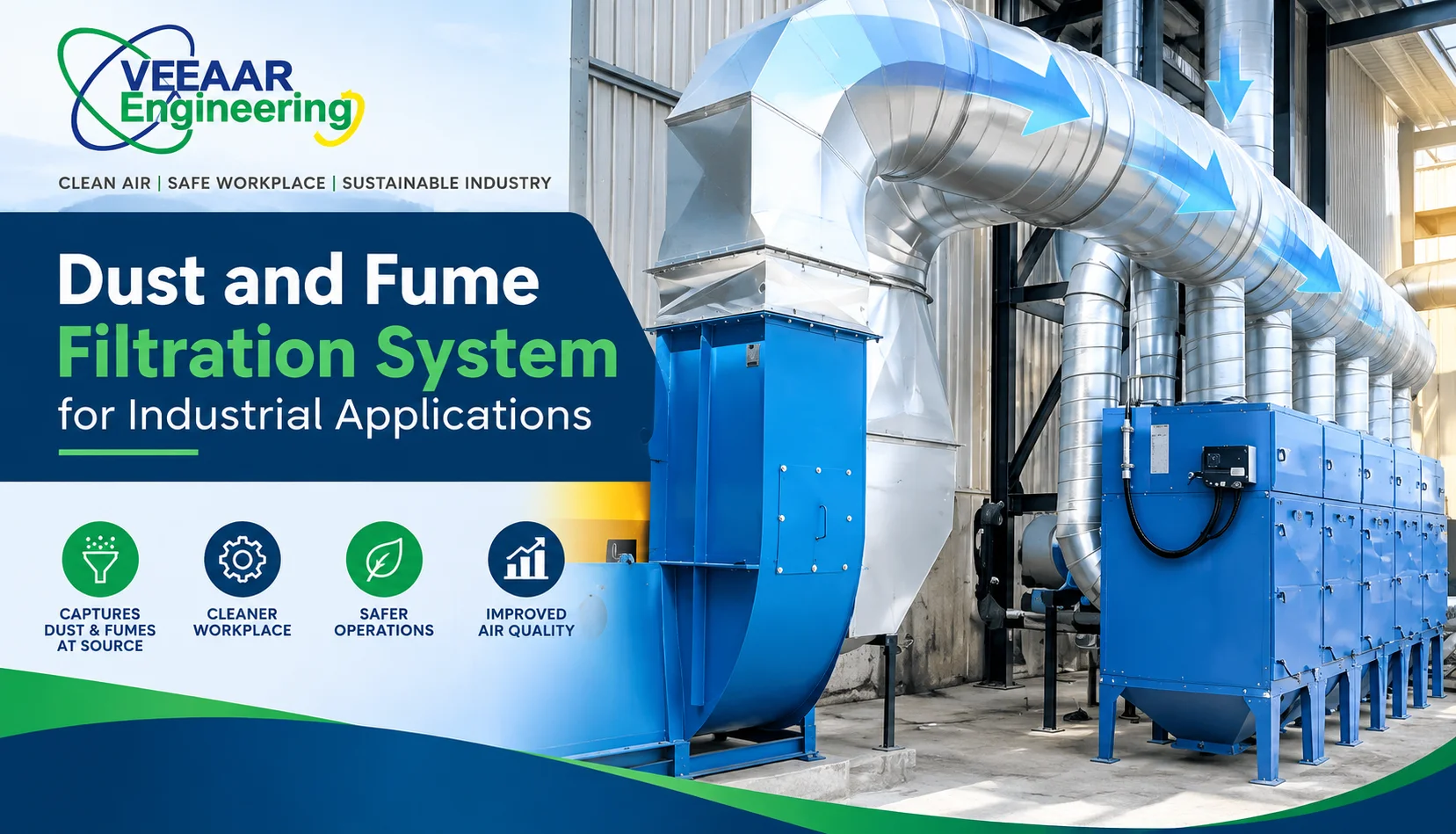
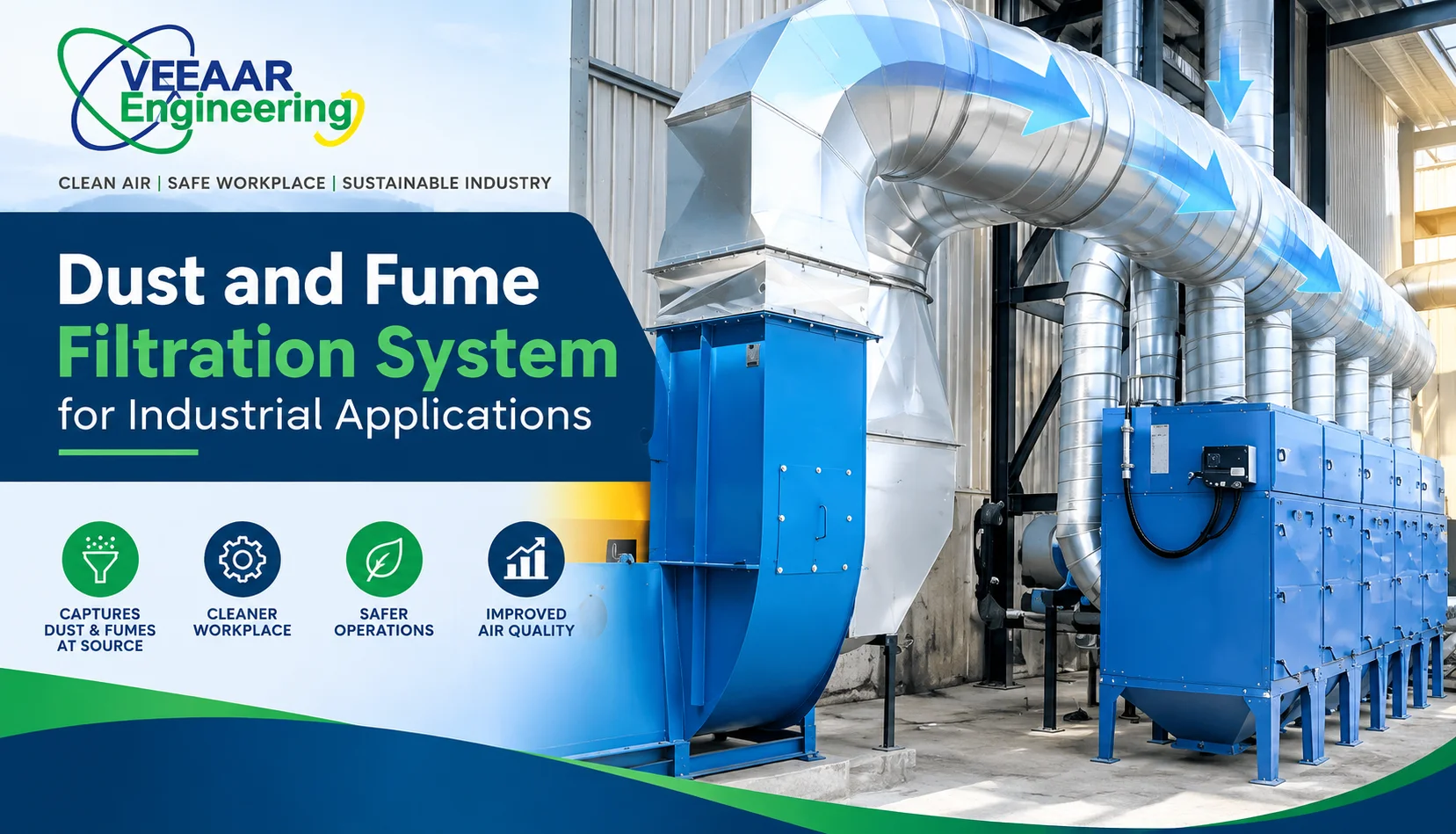
A dust and fume filtration system captures airborne contaminants close to the process, transports them through ductwork and separates them from the air before discharge or controlled recirculation. A complete system can include hoods or enclosures, ducting, a fan, pre-separation, filters or a scrubber, dust disposal, controls, monitoring and make-up air. Its job is not simply to “pull air”; it must control the contaminant without disrupting production or creating a new safety risk.
Dust and fumes behave differently. Dust consists of solid particles released by cutting, grinding, conveying, mixing or handling bulk material. Fumes are often much finer particles formed when a material is heated, vaporized and condensed, as in welding or thermal cutting; some processes also release gases or vapours. The contaminant, concentration, temperature, chemistry and hazard determine the collection method. Veeaar Engineering presents a dedicated dust and fume filtration system service for industrial applications.
Why source capture is more effective than room dilution
Capturing a contaminant near its release point usually requires less air than trying to clean an entire workshop after dispersion. A hood positioned correctly uses the process motion and enclosure to its advantage. When the hood is too far away, cross-drafts, operator movement and hot plumes can carry emissions into the breathing zone before the extraction system acts.
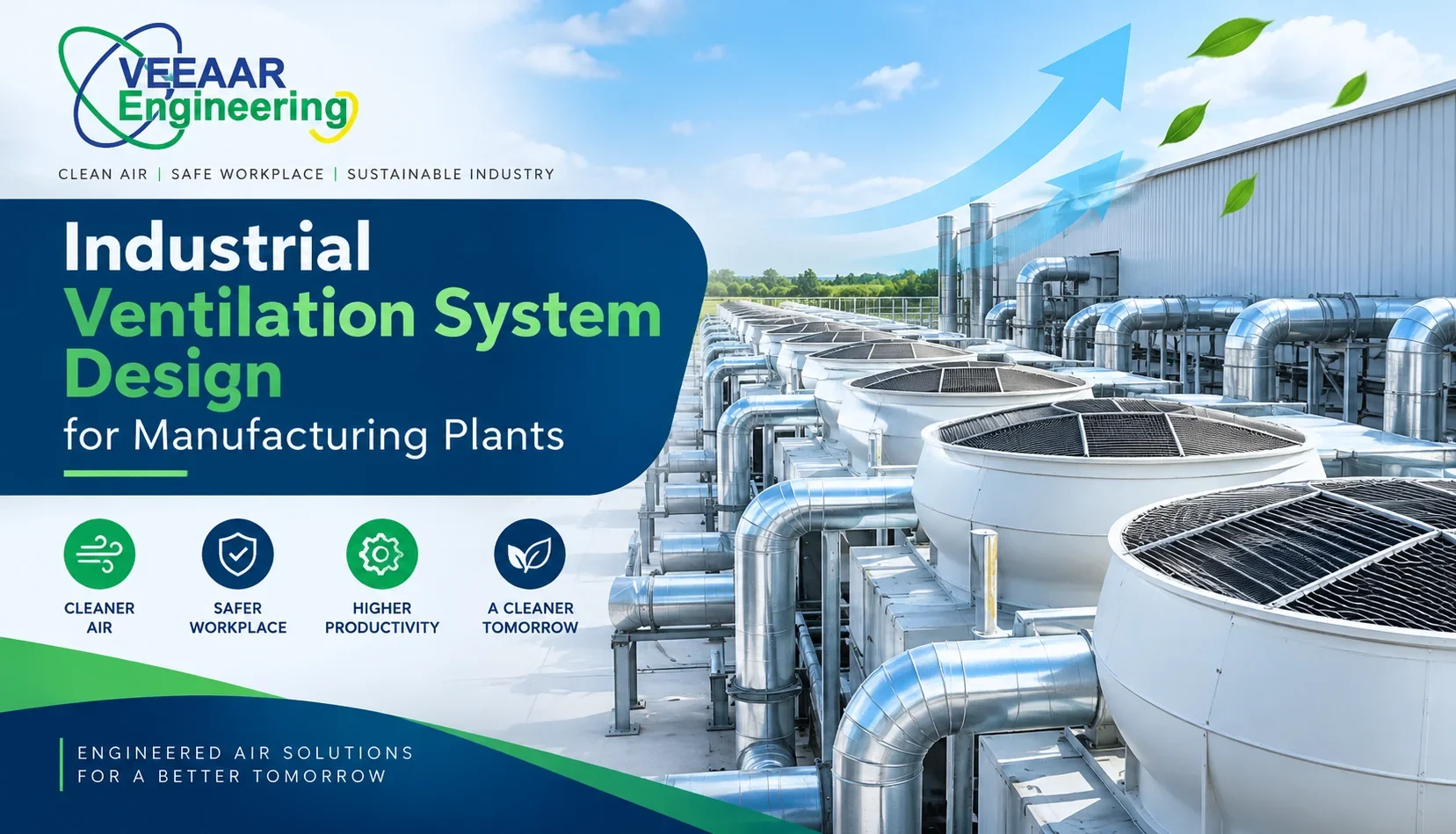
General ventilation still matters for heat, background contaminants and replacement air, but it should not be treated as a substitute for local exhaust where concentrated emissions occur. A plant-wide industrial ventilation and air filtration system should coordinate local capture, room pressure and make-up air so doors are operable, combustion equipment remains safe and conditioned spaces are not unintentionally exhausted.
Dust and fume sources across industries
| Process | Typical contaminant | Common control approach |
|---|---|---|
| Welding and thermal cutting | Metal fume, fine particulate and gases | On-tool extraction, downdraft table or movable hood with suitable filtration |
| Grinding and polishing | Coarse and fine metal dust, possible sparks | Enclosure or source hood, spark control and dust collector |
| Powder transfer and mixing | Process powder and nuisance dust | Enclosed transfer, capture hood and bag/cartridge filtration |
| Woodworking | Sawdust and fine combustible dust | Machine connection, duct network and collector designed for the hazard |
| Chemical or coating process | Mist, vapour, particulate or corrosive gas | Process-specific capture with filtration or scrubbing |
Metal fabrication and welding
Welding fume contains very fine particles and can rise in a hot plume. The hood must intercept the plume without drawing shielding gas away from the weld. Robotic cells may use enclosures or canopy arrangements, while manual stations may need movable arms, downdraft benches or on-torch capture. Grinding adds larger particles and sparks, so pre-separation and fire-risk controls may be required before the final filter.
Cement, minerals and bulk solids
Crushing, transfer points, screens, mixers and bagging operations can release high dust loads. Enclosures and correctly positioned pickup points reduce the volume that must be moved. Abrasion, material buildup and filter loading influence duct velocity, bends, hopper design and cleaning method. A collector chosen only by fan power may plug quickly or waste energy if the dust load and particle characteristics were not measured.
Woodworking and composite processing
Saws, sanders, routers and trimming stations create dust with different particle sizes. Collection connections should match the machine and maintain transport velocity through branches. Because some dusts can burn or explode, hazard assessment, ignition control, isolation, venting or suppression may be necessary. These decisions must be made by qualified specialists under applicable requirements; a standard outdoor bag filter is not automatically suitable.
Chemical, pharmaceutical and coating operations
Powder handling may require containment as well as filtration to prevent product loss, contamination or operator exposure. Corrosive gases and soluble vapours may be better controlled by a designed scrubber rather than a dry dust filter. Veeaar Engineering also provides FRP tank and scrubber systems for relevant corrosive-gas applications; compatibility and treatment chemistry must be verified for the actual exhaust stream.
The main components of an effective system
Capture hood or process enclosure
The hood is the first and often most important component. Its shape, position, flange and degree of enclosure determine how much air is needed. The design should account for contaminant release direction, thermal buoyancy, cross-drafts, operator access and maintenance. A large open canopy may look impressive yet capture poorly if workers stand between the source and hood.
Duct network
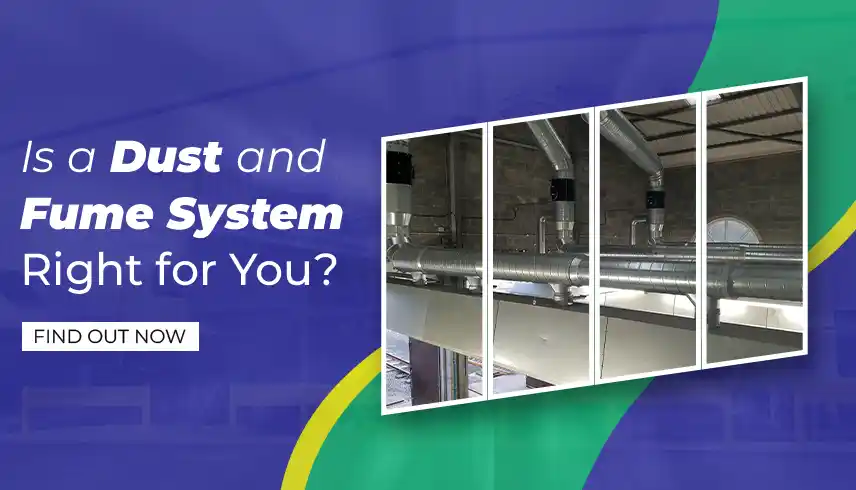
Ducts must maintain enough transport velocity to avoid settling while limiting pressure loss, noise and energy use. Branch entries, elbows, transitions and flexible hoses should be selected deliberately. Balancing devices help distribute airflow, but closing one branch can alter the rest of the network. Provide access for inspection and cleaning, and avoid long unsupported flexible duct as a permanent design solution.
Fan and motor
The fan must deliver the design airflow at the total system resistance, not only a free-air rating. Resistance includes hoods, ducts, fittings, filters, silencers and discharge. Filter loading increases pressure drop, so the operating point should be checked across the expected range. Motor, drive, material and arrangement must suit temperature, dust, corrosiveness and classified-area requirements where applicable.
Separation and filtration
Cyclones can remove heavier particles before a final filter. Bag filters handle many dry-dust applications; cartridges provide compact high surface area for suitable dusts; high-efficiency final filters may be required for very fine contaminants. Wet scrubbers may treat soluble gases, vapours or sticky particulate. The filter media must match particle size, chemistry, temperature, moisture, cleaning method and disposal plan.
Controls and monitoring
Useful controls include fan status, differential pressure, airflow indication, filter-cleaning sequence, hopper level, motor protection and alarms. Variable-speed control can save energy where demand changes, but the minimum speed must still preserve capture and transport. Monitoring should show when performance is drifting before visible dust escapes.
How engineers size airflow and pressure
A preliminary hood flow can be understood as capture velocity multiplied by the effective opening area, with corrections for hood type, distance and cross-drafts. This is only a starting concept. The designer then calculates duct transport requirements and pressure losses through every component to select the fan operating point. Each branch needs balancing so the remote hood is not starved by an easier path.
Measured process data is better than generic air-change rules. Record which machines operate together, contaminant release rate, hood dimensions, existing airflow, temperature, production shifts and future expansion. For an existing system, traverse measurements, static pressure, motor current and smoke visualization can reveal restrictions and poor capture. Changing a duct or filter without recalculating the network can move the problem elsewhere.
Choosing the right filtration technology
Begin with the contaminant: particle-size distribution, concentration, density, stickiness, abrasiveness, moisture, temperature, toxicity, combustibility and chemical reactivity. Then define required outlet quality, whether air will be discharged outdoors or considered for recirculation, and how collected material will be handled. Recirculation requires a much higher level of risk review and monitoring than simple outdoor discharge.
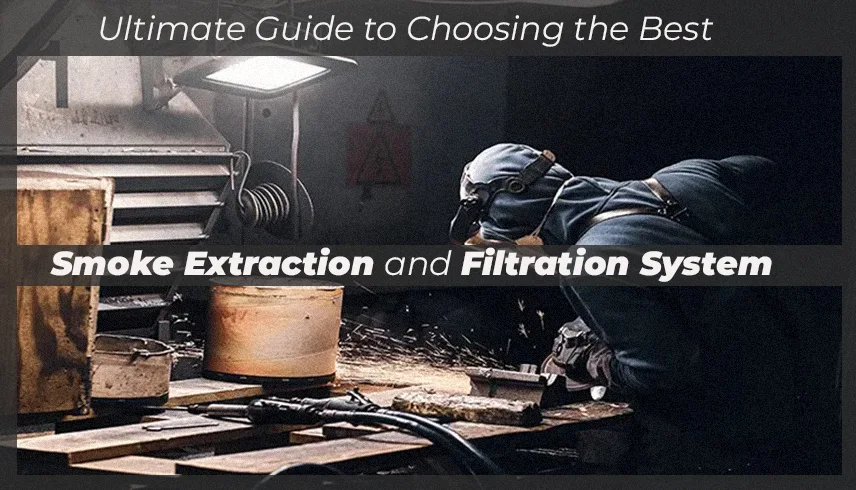
Compare suppliers on guaranteed operating airflow and pressure, filter media, cleaning mechanism, emissions basis, fan curve, noise, energy, access, spares and service—not on motor kilowatts or collector dimensions alone. Where smoke behaviour differs from process dust, review the related smoke extraction and filtration system rather than assuming one collector covers every event.
A practical supplier comparison table
| Requirement | What a complete proposal should state | Risk if missing |
|---|---|---|
| Design basis | Processes, simultaneous machines, contaminant and airflow | System may be undersized or wasteful |
| Fan duty | Flow and static pressure at clean and loaded conditions | Installed airflow may not meet capture needs |
| Filter | Media, area, efficiency basis and cleaning method | Short life, high emissions or frequent stoppage |
| Safety | Fire, explosion, toxicity and corrosive-gas provisions | Serious worker, asset or compliance risk |
| Scope | Hoods, ducts, power, civil work, commissioning and training | Cost gaps and interface disputes |
Installation and commissioning checklist
- Confirm hood locations against actual machines, operator positions and material flow.
- Verify duct supports, access doors, slopes, cleanouts and flexible connections.
- Check fan rotation, alignment, vibration, guards and motor protection.
- Inspect filter installation, seals, cleaning air and dust-discharge equipment.
- Measure airflow or pressure at critical branches and balance the system.
- Demonstrate capture under representative production, not only with machines idle.
- Test alarms, interlocks and shutdown logic where provided.
- Hand over drawings, fan curve, filter data, readings, spares and maintenance schedule.
Commissioning should compare measured values with the approved design basis. Visual smoke tests can help show airflow direction, but quantitative readings are still needed. A documented smoke and fume extraction installation can support capability review, while the buyer should request project-specific performance evidence and acceptance criteria.
Safety reviews that must happen before equipment selection
The same particles a collector removes can create a fire, explosion, toxicity or reaction hazard inside the equipment. Before choosing a filter, the project team should obtain reliable information about combustibility, minimum ignition energy where relevant, hot particles, incompatible materials and any substances that must not share a duct. The assessment may change equipment location, construction material, grounding and bonding, spark detection, isolation, explosion protection, fire response and the safe method for emptying collected waste. These safeguards are application-specific and require competent engineering; adding a generic spark arrestor does not complete the review.
Location also changes consequence. An indoor collector can expose occupied areas if a filter, duct or hopper fails, while an outdoor unit still needs safe access, weather protection and a discharge arrangement that does not affect neighbours or air intakes. Relief devices, where required, need a safe direction and exclusion zone. Process interlocks should define what happens when airflow falls, the dust bin is full or the fan trips. Operators must understand that silencing an alarm while production continues defeats the control system.
Plan collected-material handling as part of the design
Dust disposal is not an afterthought. The hopper, valve, drum or bagging arrangement should prevent re-entrainment and minimize manual exposure. Confirm whether the collected material can be recycled, is contaminated, remains hot, reacts with water or is classified as hazardous waste. Provide lifting access and a change-out method that suits the real container weight. A collector that captures well but requires workers to open a dusty hopper every hour has moved the exposure rather than controlled it.
Maintenance that preserves capture performance
Differential pressure should be trended, not checked only after dust becomes visible. Inspect hoods, dampers, flexible connections, ducts, filter seals, pulse-cleaning equipment, hoppers, rotary valves, fan belts, bearings and discharge. Empty dust safely before it bridges or re-enters the air stream. A clean filter is not the only goal: a torn or poorly seated filter may show low pressure drop while allowing high emissions.
Investigate process changes. A new machine, faster line, different powder or closed damper can invalidate the original balance. Train operators not to move hoods away, block make-up air or disable alarms. Veeaar Engineering states that it provides design and system-selection expertise; review About Veeaar Engineering when evaluating support capability and define response times, consumables and AMC scope in writing.
Common mistakes that weaken results
Common failures include placing the hood too far from the source, using one airflow figure for every process, ignoring make-up air, selecting the fan before calculating resistance, mixing incompatible fumes, undersizing dust storage and providing no access for cleaning. Another mistake is using room cleanliness as the only test; worker exposure and source capture may still be poor even when settled dust looks limited.
Avoid unsupported claims that a filtration system automatically guarantees compliance or eliminates all exposure. Performance depends on process control, correct use, maintenance and verified measurements. Occupational exposure, emissions and combustible-dust obligations should be assessed by competent professionals against current local requirements.
Frequently Asked Questions
1. What is the difference between dust extraction and fume extraction?
Dust extraction typically handles solid particles released mechanically, while fume extraction captures much finer particles and gases produced by hot processes. Hood and filter selection differ. Final equipment selection should be based on a site survey, contaminant data, process conditions, applicable safety requirements and the responsible engineer’s design.
2. Should the hood be above or beside the source?
It depends on contaminant motion, heat, process access and cross-drafts. The hood should intercept the natural path without drawing the contaminant through the operator’s breathing zone. Final equipment selection should be based on a site survey, contaminant data, process conditions, applicable safety requirements and the responsible engineer’s design.
3. Can one system serve several machines?
Yes, if simultaneous demand, branch balancing, transport velocity and future changes are engineered. A centralized system should not be sized by simply adding connection diameters. Final equipment selection should be based on a site survey, contaminant data, process conditions, applicable safety requirements and the responsible engineer’s design.
4. Which filter is best for welding fumes?
Selection depends on process, metal, consumables, loading, sparks, gases and required air quality. Cartridge or other high-efficiency media may be used with suitable pre-protection and controls. Final equipment selection should be based on a site survey, contaminant data, process conditions, applicable safety requirements and the responsible engineer’s design.
5. When is a wet scrubber preferred?
A wet scrubber may suit soluble or reactive gases, sticky particulate or streams needing cooling, provided treatment chemistry, corrosion, wastewater and mist carryover are addressed. Final equipment selection should be based on a site survey, contaminant data, process conditions, applicable safety requirements and the responsible engineer’s design.
6. Can filtered air be returned to the workshop?
Only after a rigorous contaminant, failure-mode, monitoring and regulatory review. Toxic gases or unknown mixtures can make recirculation inappropriate. Final equipment selection should be based on a site survey, contaminant data, process conditions, applicable safety requirements and the responsible engineer’s design.
7. Why does suction fall over time?
Common causes include loaded filters, blocked ducts, closed dampers, leaking connections, worn fan components, process changes or insufficient cleaning air. Final equipment selection should be based on a site survey, contaminant data, process conditions, applicable safety requirements and the responsible engineer’s design.
8. How often should filters be changed?
Use differential pressure, emissions, damage inspection and manufacturer criteria rather than a calendar alone. Operating load and cleaning method strongly affect life. Final equipment selection should be based on a site survey, contaminant data, process conditions, applicable safety requirements and the responsible engineer’s design.
9. Does a larger fan always improve capture?
No. Excessive flow can waste energy, disturb processes, increase noise and overload filters. Capture depends on hood design and balanced system resistance. Final equipment selection should be based on a site survey, contaminant data, process conditions, applicable safety requirements and the responsible engineer’s design.
10. What information is needed for sizing?
Provide process descriptions, contaminants, machine layout, hood access, simultaneous operation, temperature, production hours, existing readings, discharge route and safety constraints. Final equipment selection should be based on a site survey, contaminant data, process conditions, applicable safety requirements and the responsible engineer’s design.
11. How should system performance be accepted?
Agree measurable airflow or pressure points, capture demonstrations, emissions or exposure criteria, noise, alarms and documentation before procurement. Final equipment selection should be based on a site survey, contaminant data, process conditions, applicable safety requirements and the responsible engineer’s design.
12. Does Veeaar Engineering provide project support?
Its website describes consultation, site visits, duct design, installation and service for dust and fume systems. Confirm the exact scope and response terms in the quotation. Final equipment selection should be based on a site survey, contaminant data, process conditions, applicable safety requirements and the responsible engineer’s design.
Control Contaminants at the Source with a Measured System
A reliable dust and fume filtration system begins with the process, contaminant and hood—not a catalogue fan size. Veeaar Engineering can review machine layout, operating pattern, airflow, duct route, filter duty and service needs as one system. Contact Veeaar Engineeringwith process photos, plant drawings and contaminant details to arrange a site-based technical discussion and quotation.